



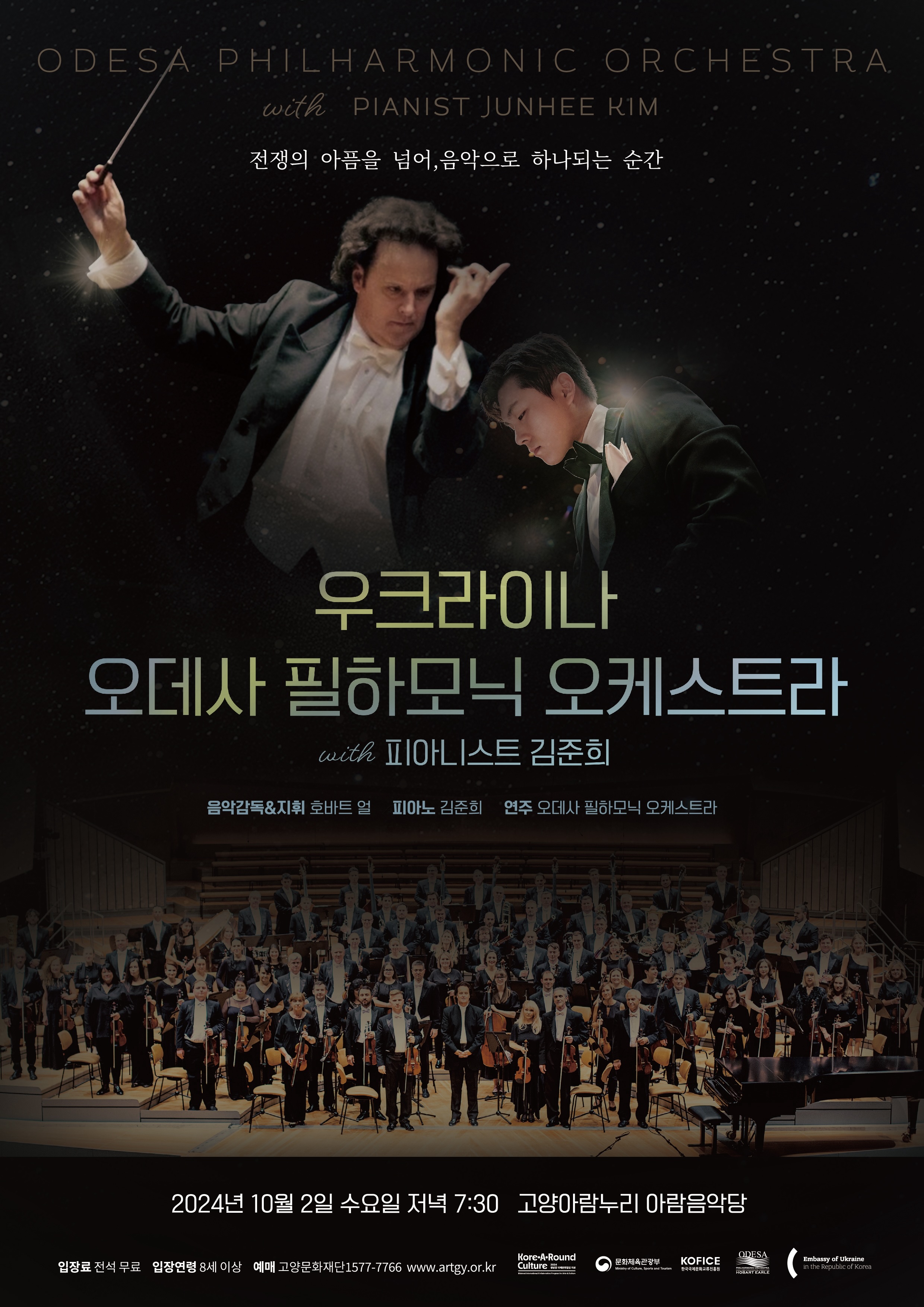
On the evening of October 2, 2024, one of Ukraine's most storied ensembles walked onto a Korean stage for the first time. The Odesa Philharmonic Orchestra — seventy-five musicians who had traveled from a country at war — gave its historic Korean debut at the Goyang Aram Nuri Arts Center, under the baton of Hobart Earle, the conductor who has led the orchestra for more than three decades and been named a People's Artist of Ukraine. The concert had a title that doubled as a mission: songs of hope.
Standing with them at the piano was Junhee Kim — and his presence was no accident of scheduling. Seven years earlier, in 2017, Kim had won the Vladimir Horowitz International Competition in Kyiv. That victory, on Ukrainian soil, forged a bond that would quietly wait until this night to find its full expression. For an orchestra carrying the weight of its homeland's suffering, and a pianist whose career had been shaped by a Ukrainian competition, the collaboration became something more than a concert — a moment of unity reaching across the pain of war.
At the center of Kim's appearance was the Korean premiere of Sergei Bortkiewicz's Piano Concerto No. 1 — a deliberate and meaningful choice. Bortkiewicz was born in Kharkiv, a Ukrainian composer whose lush, late-Romantic music had long slipped to the margins of the concert repertoire. To give its first Korean performance, with a Ukrainian orchestra, in a program built around hope, was to restore a Ukrainian voice to the stage at the precise moment it mattered most.
The concerto sat within a program of ten works spanning three centuries, tracing a line from the European canon into Ukraine's own musical heritage. It opened with the sweep of Verdi's Force of Destiny Overture and reached, later, to Ukrainian composer Miroslav Skoryk's Childhood — a piece known from the film Shadows of Forgotten Ancestors, tender and unmistakably national in character. The evening moved between grandeur and intimacy, between the familiar and the almost-forgotten.
The concert was more than an artistic event; it was an act of cultural diplomacy. Presented as part of a Korea–Ukraine collaboration, it was supported by Korea's Ministry of Culture, Sports and Tourism and the Korean Foundation for International Cultural Exchange, in cooperation with the Embassy of Ukraine in Seoul. In a season when so much of Ukraine's story reaches the world through images of destruction, this was the country speaking in a different language entirely — through its musicians, its composers, and the sound of an orchestra still standing.
For Kim, the night drew a full circle. The competition that helped launch his international career had taken place in Kyiv; now, years on, he returned that connection in the most public way possible — sharing a stage with the very culture that had once recognized him, and lending his hands to its songs of hope.
 ← Back to News & Press